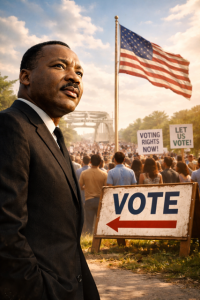
 Today we join together to wish you a thoughtful and hopeful Martin Luther King Jr Day. This is a day to reflect on the life and legacy of Dr Martin Luther King Jr, especially his deeply held belief that voting rights and democratic participation are central to justice in America. Dr King understood that without the right to participate equally in our democratic system, other rights and freedoms remain incomplete.
Dr King spoke often about the moral necessity of the vote. In his 1957 “Give Us the Ballot” speech he said that if Black Americans were given the vote they would “fill our legislative halls with men of good will” and secure freedoms that had long been denied. He believed that voting was not a mere civic duty but a powerful tool for systemic change. His view was that political rights would safeguard civil rights. He saw the vote as a means to end discriminatory laws across education, housing, employment, and public life. His words remind us that democracy is not only about winning elections but about equitable access for every eligible voter.
The State of American Democracy in 2026
As we observe Martin Luther King Jr Day in 2026 we must ask ourselves how well the United States aligns with the vision Dr King articulated. On the positive side, the Voting Rights Act of 1965 remains a foundational civil rights law that prohibits racial discrimination in voting. It has provided essential protections against discriminatory voting practices ever since it was signed into law. The act’s core provisions, including Section 2 which bans voting practices that discriminate based on race or color, remain key legal tools for challenging unfair voting laws.
Yet in 2026 America still struggles to live up to Dr King’s vision of a fully inclusive democracy. In recent years state legislatures have enacted hundreds of restrictive voting laws that make it harder for eligible voters to cast ballots. Between 2021 and 2025 at least 16 states passed 29 restrictive voting laws that will be in effect for the 2026 midterm elections. These restrictions range from stricter identification requirements to limits on mail voting and early voting.
How Modern Voting Laws Exclude Eligible Voters
One clear example is changes to mail voting policies. In several states new laws shorten the window to request and return absentee ballots, reduce the number of drop boxes, and impose harsher signature requirements. These changes disproportionately affect rural voters, older voters, people with disabilities, and voters without easy access to transportation or reliable mail service. In Georgia new restrictions reduced the number of ballot drop boxes in major counties from 111 to 23, limiting convenient ballot return options for many.
Other changes include laws requiring documentary proof of citizenship to register to vote. Proposed federal legislation called the Safeguard American Voter Eligibility Act would require proof such as a birth certificate or passport to register, even though such documentation is not held by millions of eligible Americans today. Requiring these documents could make registration significantly harder and discourage participation.
These kinds of policies are not spread evenly across the electorate. Research shows that voters of color, low-income voters, and voters with limited English proficiency are more likely to face difficulties when states impose strict voter ID requirements, eliminate ballot drop boxes, and shorten mail ballot windows. The cumulative effect of these restrictions is to place heavier burdens on communities that Dr King fought to empower.
Why the Voting Rights Act Still Protects Democracy
The Voting Rights Act remains crucial because it provides legal standards and tools to challenge discriminatory practices. Even though the Supreme Court weakened a key part of the law in Shelby County v. Holder in 2013, the act’s remaining provisions still prohibit racial discrimination and allow voters to bring legal challenges to unjust laws. Without the protections in this act, it is far easier for states to enact policies that produce unequal access to the ballot box. Recent cases involving racial gerrymandering and discriminatory redistricting plans show that Section 2 continues to be a powerful mechanism for defending fair representation.
The act matters most for voters who face systematic barriers. It enables community organizations and individuals to go to court when states adopt policies that dilute the voting power of racial and language minority groups. It has also inspired state-level voting rights acts that fill in the gaps left by federal law and provide additional protections tailored to local needs.
Turning Dr King’s Vision Into Action
If we are honest, America still falls short of Dr King’s vision of an inclusive democracy where every eligible voter can participate fully. Political leaders in both parties bear responsibility when they prioritize partisan advantage over broad access to the ballot. When state legislators enact laws that disproportionately burden specific groups of citizens without clear evidence of need, they weaken public trust in democratic institutions.
Ordinary Americans can make a difference. Educating yourself and your community about voting rules in your state is a powerful first step. Volunteering with nonpartisan voter registration and ballot access efforts helps ensure eligible voters know their rights and can participate. Contacting your federal representatives and urging them to support strong voting rights legislation in Congress sends a clear message that democracy matters more than partisan gains. You can also serve as a poll worker, assist older or disabled neighbors with early voting, and share accurate information about deadlines for registration and ballot submission.
Two Simple Ways to Strengthen Democracy Today
As we honor Martin Luther King Jr’s legacy and recommit to expanding democratic participation, we ask you to take two concrete actions.
First, help us grow our community by visiting our homepage and entering your email address to join our subscriber list. Click here to subscribe. The more voices we have working for fair and inclusive democracy, the stronger we become.
Second, if you are able please donate to One Nation Every Vote (OneV) to support our work telling the stories of American voters and increasing turnout in the 2026 midterm elections. Click here to donate.
Thank you for standing for democracy and for believing that every eligible voter should have a fair and equal chance to make their voice heard.
Leave a Reply